
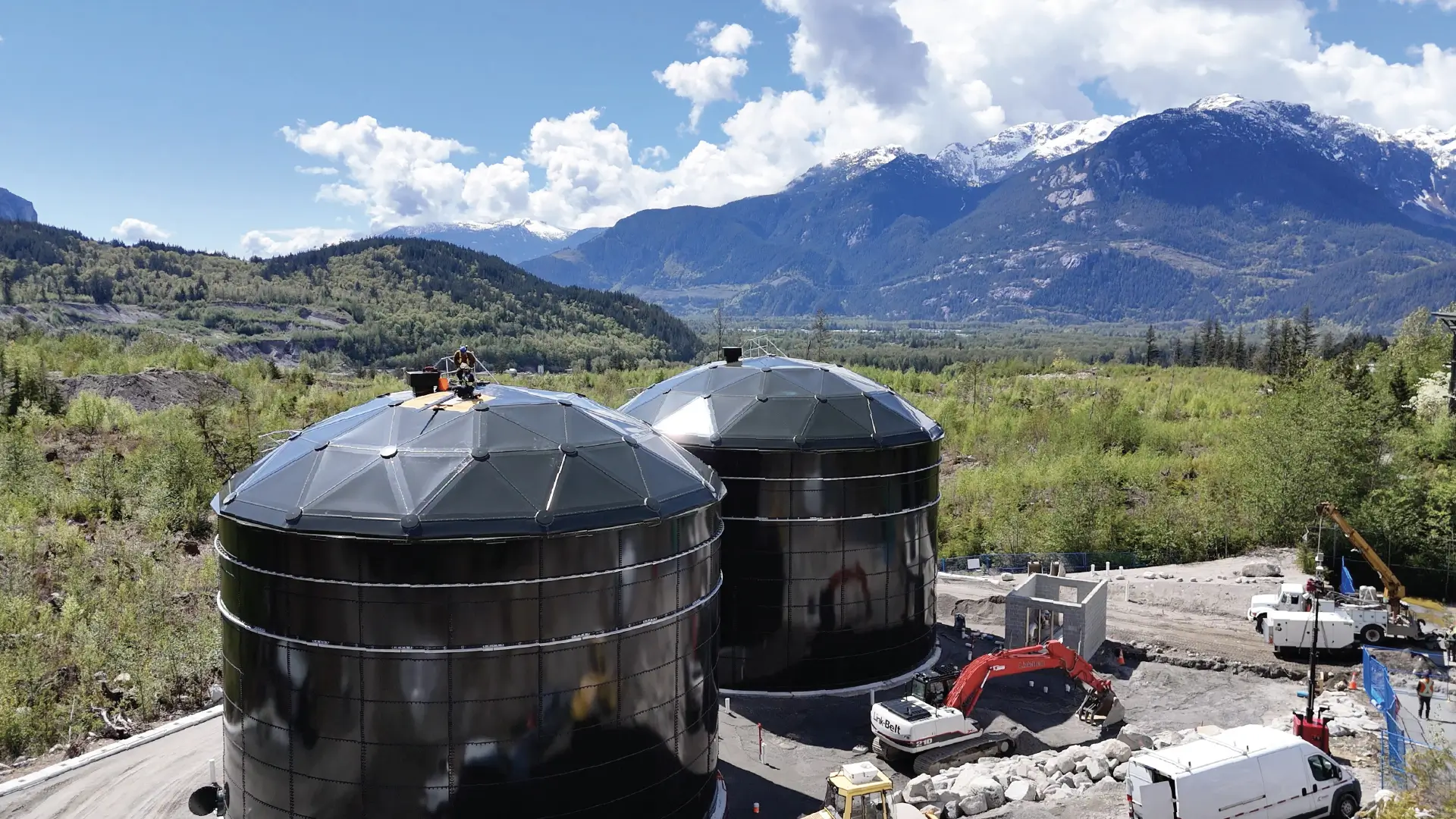
Some communities want their water tanks to be seen.
They become community markers. They carry municipal logos, town names or colours that can be spotted from the highway.
In Squamish, British Columbia, the challenge was almost the opposite.
Located at the northern end of Howe Sound along the Sea to Sky Highway, Squamish is one of British Columbia’s fastest-growing communities and one of Canada’s most recognizable outdoor destinations. Home to approximately 25,000 residents, the community sits within the traditional territory of the Squamish Nation and is surrounded by mountains, forests, rivers and ocean.
That combination of rapid growth and extraordinary natural surroundings creates an interesting infrastructure challenge: Squamish needs the water systems required by a growing community, but those systems are being built in a place where the landscape is central to the community’s identity.
“We don’t usually get asked to make the tank less visible,” says Stuart Reece, Greatario’s Regional Sales Manager for Western Canada. “When they said, ‘We want this to blend in,’ that was a unique challenge.”
It made sense.
Set between the Coast Mountains and Howe Sound, Squamish is a place where the surrounding landscape is difficult to ignore. Adding millions of litres of essential new water storage near a residential area meant thinking carefully about more than capacity alone.
The reservoirs still had to perform the serious work expected of municipal water infrastructure: store potable water, strengthen emergency fire protection, accommodate community growth and operate within demanding seismic and environmental conditions.
They just didn’t need to announce themselves while doing it.
The project began with a practical infrastructure problem.
With a population of approximately 25,000 and continued residential and commercial growth, Squamish has been facing the infrastructure challenge common to many fast-growing communities: increasing capacity without compromising long-term system resilience.
The District of Squamish’s existing Lower University Reservoir held approximately 226,000 litres. The District’s Water Master Plan had identified a storage deficiency at the site, while continued community growth was placing more demands on the water system.
The solution was significant: two new reservoirs, each designed to hold approximately two million litres of water.
Together, the project added approximately four million litres of water storage to the municipal system. According to the District, the additional capacity was intended to enhance fire protection, accommodate growth and improve operations at the Powerhouse Springs wellfield by allowing its pumps to run more evenly. These reservoirs supply water to the areas north of Mamquam River.
Squamish has placed a strong emphasis on environmental stewardship and protecting the natural environment as the community grows. On a highly visible infrastructure project, that meant considering not only what the reservoirs needed to do, but how they would sit within the landscape around them.
Greatario was retained as a subcontractor to design, supply and install the two potable-water reservoirs.
The scale matters, but so does the configuration.
For critical community drinking water infrastructure, having more than one reservoir can provide important operational flexibility. A reservoir will eventually need to be inspected, maintained or taken temporarily out of service. The water system, however, still needs stored capacity for everyday consumption and emergency fire demand.
“You need to be able to take a tank out of service and still retain water for fire protection and consumption,” Reece explains.
That is one reason redundancy matters in water infrastructure. Storage is not simply about meeting an average day’s demand. A municipal system also has to be able to respond when something changes.
The District publicly noted from the outset that the new reservoirs would be visible from the neighbouring university lands, while impacts on nearby views were expected to be limited by the site’s topography, trees and vegetation.
That put appearance into the project conversation early.
A conventional cobalt blue storage tank would have stood out against a heavily forested mountainside. Instead, the reservoirs were constructed using forest-green glass-fused-to-steel panels.
Then came another detail.
The roof needed to match.
Greatario worked with the general contractor to supply a coated aluminum geodesic dome roof in a complementary green finish. Matching the two systems sounds straightforward until the materials are considered: the tank wall and dome roof are different products, manufactured and finished differently.
“Even matching the colours was a unique challenge,” says Reece.
The objective was not camouflage in a literal sense. These remain major pieces of municipal infrastructure, approximately 10 metres high and 16 metres in diameter according to the District’s project specifications.
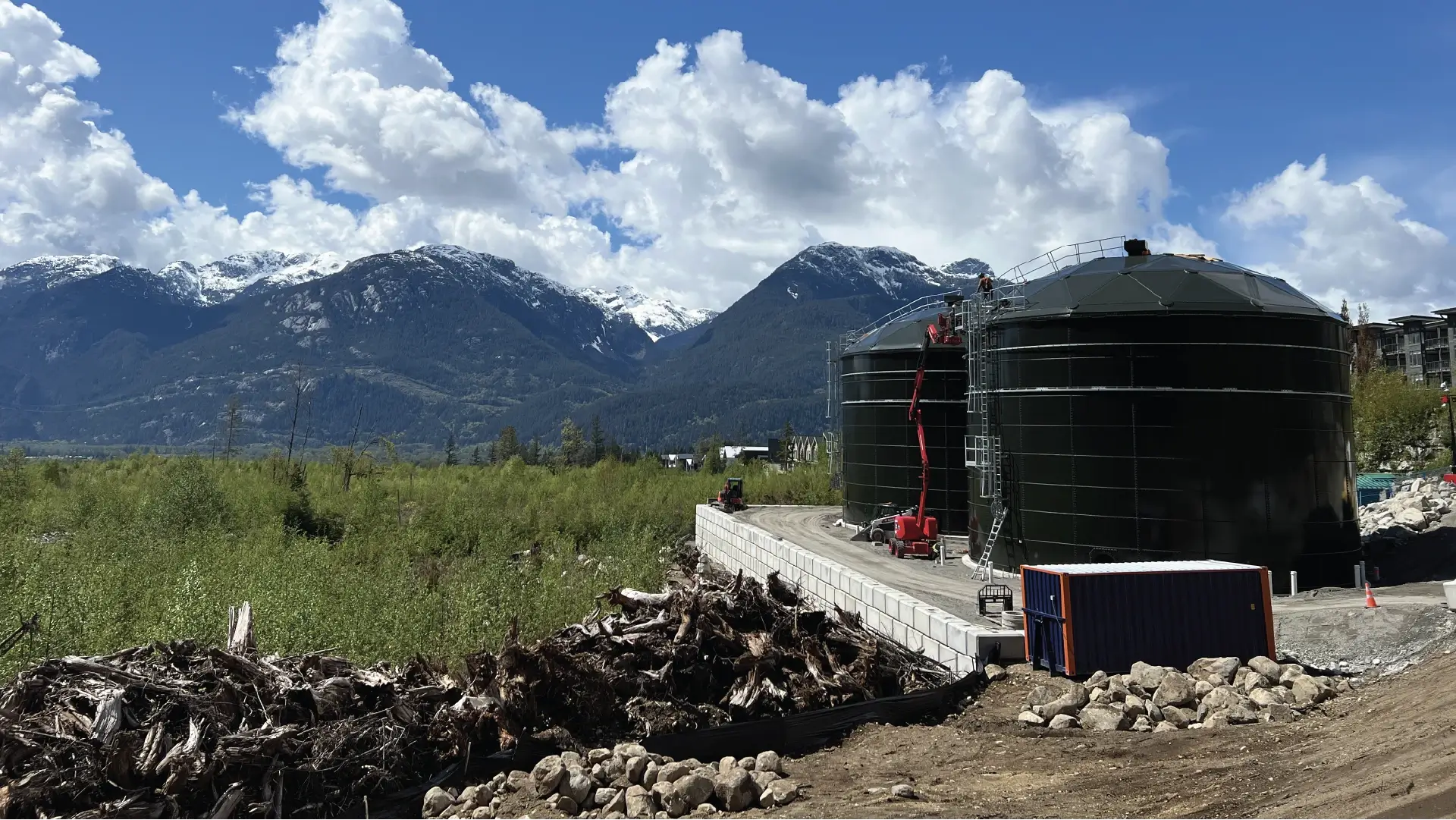
But colour dramatically changes how an object of that size reads against its surroundings.
Against the trees, the reservoirs recede.
And in Squamish, that was the point.
“People there are proud of the views and proud of how beautiful it is,” Reece says. “They’re happy to have the infrastructure. They’re also happy that it isn’t becoming the landmark.”
There is an important distinction here.
Making infrastructure fit its surroundings does not mean allowing aesthetics to dictate engineering.
Reservoir dimensions, usable storage, roof systems, foundations and structural design all have to respond first to the conditions in which the tank will operate.
In Squamish, seismic design was a particularly important consideration.
Water does not remain perfectly still inside a reservoir during seismic movement. It moves, or sloshes, creating forces that have to be considered when the structure is engineered. Sufficient freeboard, the space between the normal water level and the roof of the tank, must also be accounted for.
That creates an interesting design tension on a project like this one.
A taller reservoir could potentially provide additional physical volume within a smaller footprint, but more height would also make the structure more prominent in surrounding views. At the same time, designers cannot simply change tank proportions for visual reasons. Seismic loading, usable water volume, freeboard, foundation conditions and system hydraulics all influence the final geometry.
“You need space for the water to move,” Reece explains. “In a serious seismic area, those requirements become part of how the tank is designed.”
The site’s elevation also plays a role within the wider water distribution system. Topography can help provide distribution pressure, but the reservoir itself still has to be engineered for the structural and operational conditions of its location.
The final result is therefore less about hiding a tank than solving several constraints at once: storage capacity, fire reserve, seismic performance, distribution requirements and visual impact.
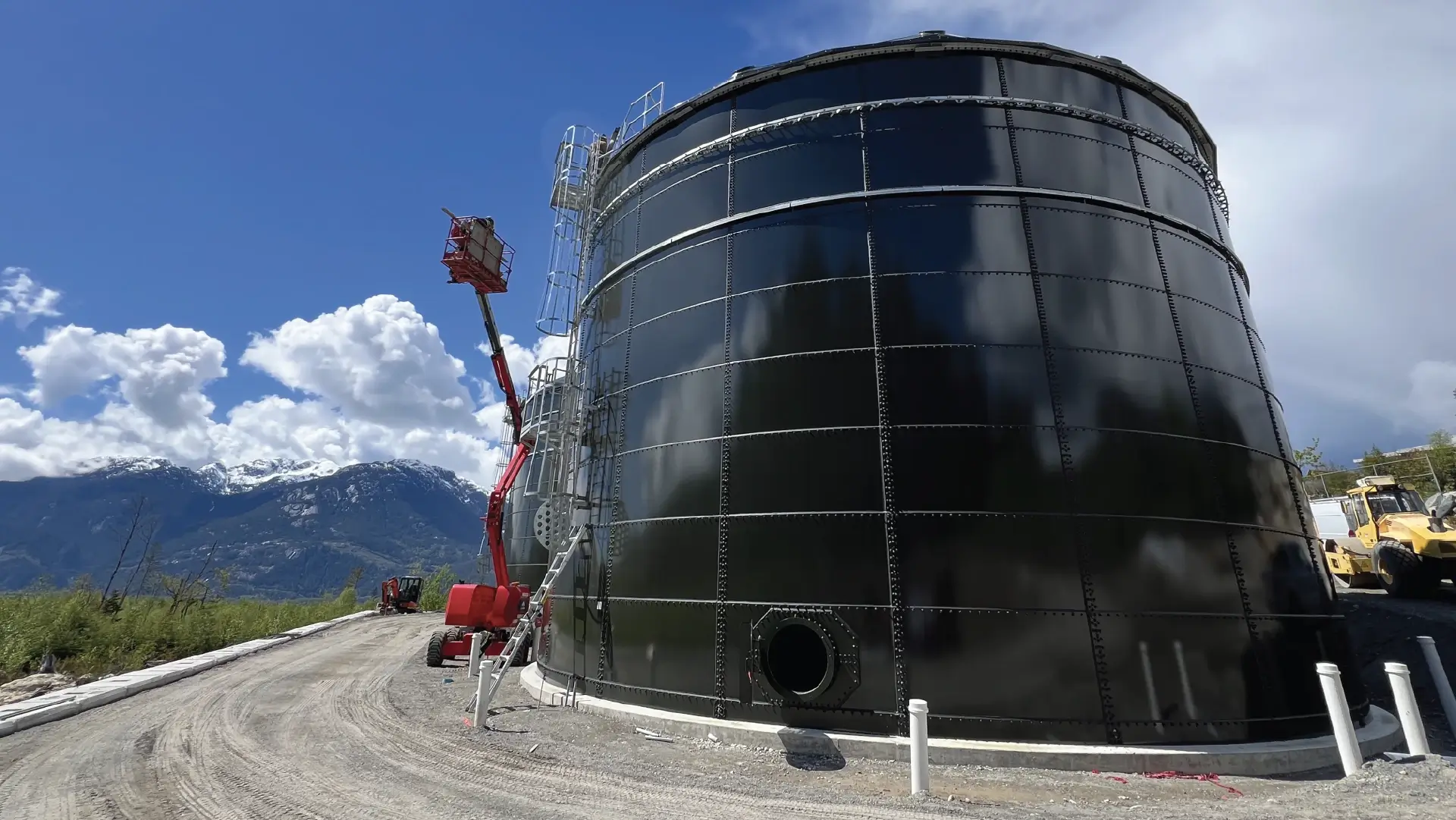
The reservoirs themselves use a glass-fused-to-steel coating, a system in which the glass coating is fused to steel panels in a furnace under controlled factory conditions before the tank is assembled onsite.
For municipalities, the appeal is practical.
Greatario’s glass-fused-to-steel systems are designed for long-term potable water storage, with a corrosion-resistant surface and modular panel construction that reduces the need for eventual recoating associated with many conventional painted steel tanks.
That modular construction method also matters during installation. Instead of fabricating an entire vessel onsite, manufactured panels are assembled into the engineered reservoir structure at the project location.
On the Squamish project, the material also offered something unusually important: an available forest-green finish that helped the walls visually connect with the surrounding landscape.
The aluminum geodesic dome completed the effect.
Rather than applying green paint to a standard aluminum roof after installation, the roof components were supplied with the specified factory applied finish. The dome retained the structural and operational role required of the reservoir roof while avoiding a bright metallic surface above the green tank walls.
Form followed function.
Then the finish made the function fit the place.
The landscape that made the finished reservoirs impressive also made construction more demanding.
The elevated site brought periods of cold, snow, ice and muddy ground. Walking and moving equipment around an active construction site became more difficult as conditions changed.
For crews that build water and wastewater infrastructure across Canada, winter conditions are familiar. Familiar does not mean inconsequential.
Cold-weather construction requires crews to continually manage access, footing, materials, equipment and safe working conditions while maintaining the installation tolerances and quality requirements of the reservoir system.
Reece laughs about another hazard of working in Squamish.
The scenery may have been distracting. The conditions were not.
The job still required the discipline that major water reservoir construction demands, particularly when work is taking place close to homes and within a constrained site.
And that became part of the project story too.
Residents may never think about the millions of litres of drinking water stored behind their neighbourhood.
They do notice a construction crew arriving every morning.
They notice when work begins. They notice noise. They notice trucks, mud, debris and how a site is left at the end of a day.
That makes construction itself part of the community experience of an infrastructure project.
The feedback Greatario received during and after construction was particularly positive, Reece says, including comments about the crew, the cleanliness of the worksite and respect for construction hours.
“Sometimes we’re working in a very confined space,” he says. “Our crews are clean, they adhere to construction times. You know you’re doing something right when people start bringing coffee and homemade cookies to the crew.”
It is a small detail in a multi-million-litre infrastructure project.
It is also revealing.
Engineering performance and proper industry inspections and tank care will ultimately determine whether a reservoir succeeds over decades. But municipalities build infrastructure in communities, often beside the people who will depend on it.
How the work is conducted matters.
Greatario works on projects where the opposite design choice makes perfect sense.
Some owners want a tank to stand out. A municipal water tower might carry a community name. An industrial facility may deliberately position its branding where thousands of drivers can see it every day.
Those projects use infrastructure as a visible asset.
Squamish shows there is another option.
A municipal water storage reservoir can be substantial without dominating the landscape around it. Material selection, tank proportions, roof design, colour and site placement can all be considered alongside the fundamental engineering requirements of the system.
The District of Squamish reported that the two new reservoirs had reached substantial completion.
Four million litres of new storage had been added to help serve a growing community, strengthen fire protection and improve the efficiency of the municipal water system.
Yet one of the most interesting measures of the project’s success is considerably harder to quantify.
The tanks are there. They work.
And against the forested mountainside, they do not demand to be noticed.
For Reece, that is the broader lesson for municipalities and infrastructure planners.
Good water infrastructure needs to respond to the system it serves. Great water infrastructure also responds to the place where it has to live.