
I was born and raised in Halifax, and I’ve lived in Nova Scotia my entire life.
When I was younger, I was convinced I would eventually leave. Maybe Toronto. Maybe Alberta. Maybe somewhere abroad.
I never did.
The older I get, the luckier I feel that I’ve been able to build my life and career here.
Atlantic Canada has a pace and personality that are difficult to replicate. Our communities are large enough that there is always something new happening, but small enough that you regularly have those “small world” moments. Someone you meet on a project worked with someone you went to school with. An engineer you’ve known for years appears on something completely different. Relationships carry from one project, community and stage of your career to another.
Working in water infrastructure has given me another way to see the region.
And right now, there is a lot changing.
This October, I’ll be joining the Greatario team in Moncton for the 2026 Atlantic Canada Water & Wastewater Association Annual Conference, taking place October 4–6 at the Delta Beausejour Hotel.
The theme this year is Flowing Forward: From Scarcity to Sustainability, and Greatario is proud to participate as the Platinum Entertainment Sponsor during a milestone year for our company: our 40th anniversary.
For me, those two things fit together.
Forty years gives you a lot to look back on.
It also gives you a pretty good foundation for thinking about what comes next.

Evan MacAuley
Technical Sales Manager | Atlantic Region
One of the biggest changes I’ve seen in Atlantic Canada is population growth.
It wasn’t that long ago that the conversation in many communities was about how to attract people and keep them here.
Today, I’m increasingly having a different conversation.
Communities are reassessing infrastructure needs because development and growth are happening faster than they may have anticipated.
That affects housing. It affects transportation. It affects utilities.
And it absolutely affects water.
If a community wants to support a new subdivision or significant housing development, it has to be able to provide the underlying infrastructure that makes that growth possible. Water does not always get the attention that the development above ground gets, but it has to be there.
That means municipalities and their engineering partners are having to think carefully about potable water storage, distribution, capacity, future demand and how infrastructure investments made now will perform years or even decades from today.
At the same time, there are only so many infrastructure dollars to go around.
That tension is important.
The need is growing. Budgets are finite. And the assets being built are expected to serve communities for a very long time.
Those conditions make good engineering, long-term planning and the right project partnerships even more important.
One thing I think is easy to forget when you work in this industry every day is just how significant these projects are for the communities purchasing them.
A municipality may need a new water storage tank only once every few decades.
This isn’t an everyday purchase.
It’s a major capital investment that has to work, has to last and has to serve the people who rely on that system long after the project team has moved on.
That changes how I think about the work.
There really isn’t such a thing as a completely typical project.
Every site seems to have something. A space constraint. A difficult elevation. Existing infrastructure. Access challenges. An unusual process requirement. A schedule issue. A design consideration that changes how the project has to be built.
That’s part of what makes this work interesting.
An engineering team comes to us with the parameters the project has to meet. Our job is to help figure out how those requirements translate into something that can actually be constructed, operated and maintained.
That’s where the relationship between engineering and industry becomes especially important.
I’ve worked with many consulting engineers throughout my career.
One thing I’ve learned is that engineers generally do not need another big marketing presentation telling them how great a product is.
They need useful information.
They need to know:
Consulting engineers sit in an important position between industry and the owners and communities ultimately using the infrastructure.
Their responsibility is to their client.
When an engineer puts a seal on a drawing or design, they’re standing behind it professionally. They need to be able to trust the technical information they’re receiving from the companies around the project.
To me, that means honesty has to come before the sale.
If something isn’t going to work, say it.
If it isn’t the right solution, say that too.
If there is a better approach, even if it doesn’t happen to be the most commercially attractive answer for us, that’s the conversation we need to have.
Trust isn’t built by saying you’re trustworthy. It’s demonstrated project after project, conversation after conversation. And I genuinely want engineers to use us that way.
I’d rather have the awkward or difficult conversation early than have people dance around an issue that we could have solved together.
The upfront capital cost of infrastructure matters. So does what happens after it’s built.
One of the reasons glass-fused-to-steel tanks have become an important part of municipal water infrastructure is the combination of constructibility, durability and lower ongoing maintenance requirements compared with systems that may require regular recoating or repainting.
For municipalities, lifecycle requirements matter because capital budgets and operating budgets are not necessarily the same thing.
A solution that can be cost-effective to construct and require less ongoing maintenance can be valuable when municipalities are planning across the entire life of an asset.
The same thinking applies to the infrastructure already in place.
Inspection, cleaning and preventative maintenance need to be part of asset planning, not something that begins only after a problem appears.
That’s especially important when communities are trying to balance new infrastructure needs with maintaining the systems they already have.
Sustainability, in that sense, isn’t an abstract idea.
It is also about making smart decisions about what we build, how long it lasts, what it takes to maintain and whether the solution continues to serve the community well over time.
Forty years of building tanks means there are quite a few Greatario tanks around.
Especially in Atlantic Canada.
I’ve joked that you almost can’t throw a rock without hitting one.
Please don’t actually throw rocks at water tanks.
When we’re driving around as a family, I’ll point them out.
“There’s one.”
Then another one.
My kids eventually get tired of it.
Sometimes I’ll suggest that we go look at a tank and get the sort of enthusiastic response you’d expect from children being invited to inspect municipal infrastructure with their father.
“All right, Dad. Let’s go see a tank.”
When I first joined Greatario, one of the things I started doing was taking pictures of them.
If I was in a community and knew there was a Greatario project nearby, I’d drive over. I’d look at the tank. I’d take some photographs. I’d check the nameplate.
Built in 2001.
Built in 1998.
And then I’d start wondering why something had been designed or built a particular way.
Here’s the part I still find remarkable.
In many cases, I can pick up the phone and speak to someone at Greatario who was actually involved in building it.
I’ll ask why they did something a certain way.
And they remember.
They remember what was happening on the site. They remember the challenge. They remember why a decision was made.
Sometimes they’re describing the details of a project built decades ago as if it happened last week.
That is what 40 years of water infrastructure in Canada means to me.
I’m physically looking at infrastructure that has been standing in a community for decades while still having access to the people and institutional knowledge behind it.
You can’t manufacture that overnight.
It gets built one project at a time.

Over four decades, you’re going to encounter difficult projects.
That’s simply reality.
What matters is how a company responds.
One thing I appreciate about Greatario is the depth of knowledge we can draw from when something unexpected happens. There may be someone elsewhere in the company who has encountered something similar. There may be a project manager who solved a comparable issue. There may be a crew member, supplier or technical partner who sees an answer someone else hasn’t considered yet.
The conversation has to stay focused on solving the problem.
For me personally, there’s also a very simple test at the end of a project:
Would this customer be comfortable choosing to work with us again?
Even if the project encountered issues. Even if something unexpected happened. Did we work through it in a way that left the customer confident in the relationship and the finished infrastructure? That is the outcome that matters.
It also comes back to the people actually doing the work. Our crews make the clock move on every project. Nothing starts or finishes without them.
That experience isn’t something Greatario treats as disposable labour moving from project to project.
There is ongoing training, certification, shared learning and a significant amount of knowledge built into the people doing the construction.
When you are selecting a project partner, that depth matters too.
That’s one reason I like the theme of this year’s ACWWA conference.
Flowing Forward: From Scarcity to Sustainability captures a lot of what the industry is working through.
Communities are growing.
Infrastructure is aging.
Budgets have limits.
Assets need to perform for decades.
And engineers and municipalities are being asked to plan for future conditions while still meeting today’s very real needs.
There isn’t going to be one solution to all of that.
There rarely is.
What we can do is bring good information to the table earlier, learn from what has already been built, select solutions based on the actual needs of each project and make decisions with the full life of the infrastructure in mind.
That’s the kind of conversation I’m looking forward to having in Moncton.
Greatario is proud to be the Platinum Entertainment Sponsor and Sunday Meet & Greet Sponsor of the 2026 ACWWA Annual Conference, October 4–6 at the Delta Beausejour Hotel in Moncton.
And because we’re celebrating our 40th anniversary, we’re not exactly planning to be subtle about it.
40 Years Behind Us. Built for What’s Ahead.
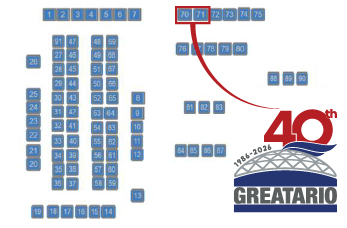
You’ll find us at Booths 70 & 71 throughout the conference, but there’s plenty happening beyond the booth too.
On Sunday night, join us at the Welcome Meet & Greet for the Greatario People’s Choice Water Taste Test and Think Tank Trivia, where Greatario is adding some very worthwhile prizes to the competition, including another Milwaukee 5-Tool Combo Kit and $300 in gift cards.
Apparently, even trivia has higher stakes this year.
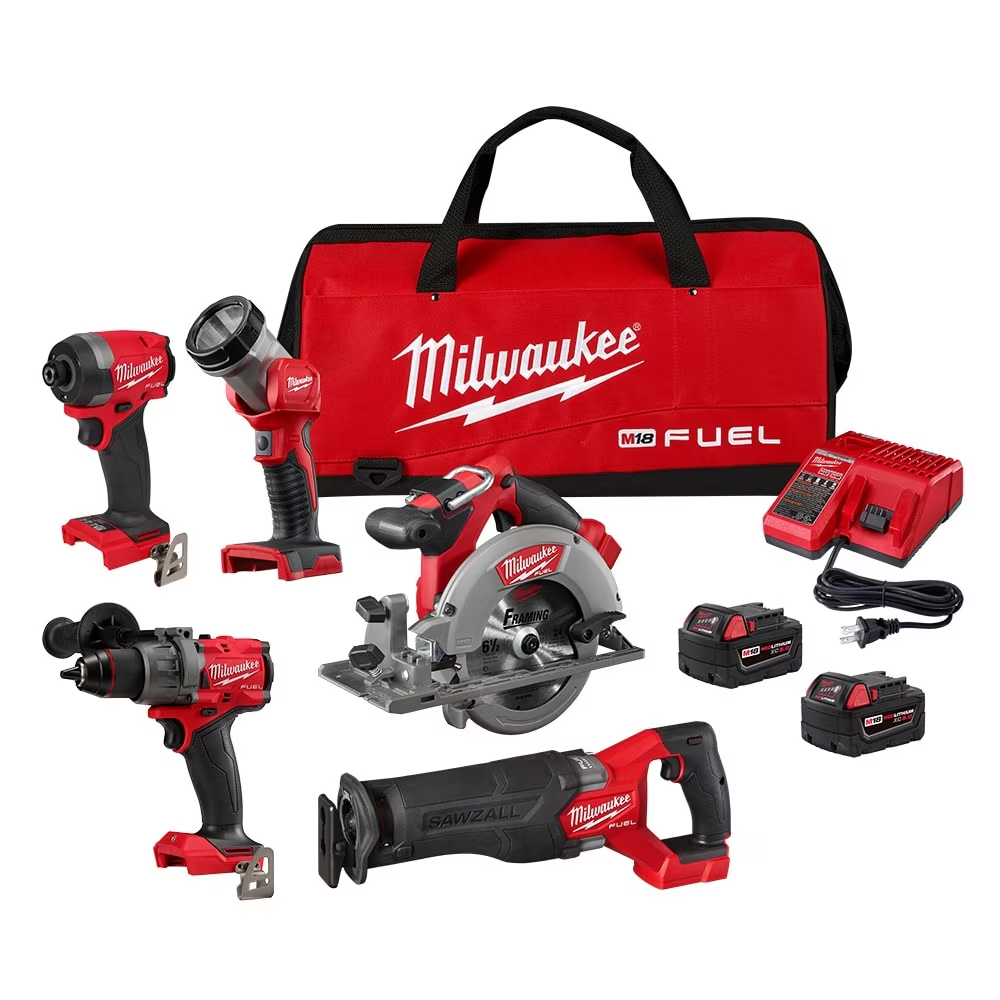
We’re also marking four decades of Greatario with four Milwaukee prize packages worth more than $3,000, one representing each decade of Greatario.
And one of them could be yours.
To enter:
We’re hoping that by the end of the show, the map will tell its own story.
Forty years of projects.
Communities across the region.
And a room full of the engineers, operators, municipalities and infrastructure professionals who will shape what gets built next.
New this year, Greatario is also sponsoring the People’s Choice Taste Test during the ACWWA Meet & Greet.
Seven municipalities will have the chance to put their drinking water to the test. Delegates will receive an ACWWA souvenir shot glass, sample the seven entries and vote for their favourite.
Seven municipalities. Seven samples. One People’s Choice winner.
And, presumably, municipal bragging rights for at least the next year.
Enter Your Municipality’s Sample
Participation is limited to seven municipalities on a first-come, first-served basis. Sample forms must be submitted by September 25, 2026.
Between the booth, the draw, the taste test, the golf tournament and everything else happening throughout the conference, there should be plenty of opportunities to find us.
And that’s really the part I’m looking forward to.
Whether you have an active project, something early in planning, a technical question, or we simply haven’t seen each other in a while, come talk to us.
Christopher Luney, Jeff Rodger, Scott Plant, and Joey Sutherland and I will all be in Moncton.
And yes, you are absolutely allowed to demand that I come talk to you.
Technical Sales Manager | Atlantic Region
Evan leads regional market development across Atlantic Canada, strengthening customer relationships and supporting Greatario’s growth with expert guidance on engineered water storage solutions.


